

 English
 русский

A check valve for gas is a one-way valve that opens with forward flow and shuts by itself the moment flow stops or reverses, keeping gas from travelling back through the line. Because gas carries almost no viscosity and leaves no liquid film on the seat, a gas check valve lives or dies on three details: seat geometry, cracking pressure and closing behaviour. Body shape and price come a distant fourth.
That is the short answer, and it explains why two valves of the same size and pressure class can behave nothing alike on the same line. One seals bubble-tight for a decade; the other chatters from commissioning day and is passing gas by its second season. The cause is rarely the casting. It is usually a soft seat running too hot, a spring too stiff for a low-flow line, or a valve installed where gravity works against the disc.
Before comparing catalogues, fix four numbers: pressure class, bore, cracking pressure and seal material. End connections, body style and test standard all follow from those.
Content
- What a gas check valve must do that a liquid valve does not
- Which check valve type fits which gas line
- Sizing and specification: the numbers that decide performance
- Installation mistakes that shorten gas check valve life
- Where gas check valves earn their place
- A short purchasing checklist
- Frequently asked questions
What a gas check valve must do that a liquid valve does not
Gas service is harder on a check valve than liquid service in three specific ways: seats run dry, discs close fast, and the differential pressure available to hold the valve open is often small.
Dry sealing
Gas leaves no lubricating film behind, so a scratched seat face or a compression-set elastomer becomes a measurable leak rather than a weeping joint. Name a leak class in the specification instead of relying on the phrase "bubble tight".
Fast closure
Low density means the disc accelerates hard when flow reverses, and that energy lands on the seat and on the piping. Short-lift, spring-assisted or damped designs take the slam out of the closure.
Low differential
On a low-flow gas line there may be only a fraction of a bar to hold the disc off its seat. A heavy spring in that duty means the valve never fully opens; too light a spring means flutter and seat wear.
Cracking pressure — the differential at which the valve first opens — is therefore the single most misjudged number on a gas data sheet. The table below shows where typical gas duties land; treat the values as starting points to confirm against the valve datasheet and the actual flow range, not as universal rules.
| Gas duty | Typical cracking pressure | Reasoning |
|---|---|---|
| Fuel gas to burners or generator sets | 0.5–2 psi | A stiffer spring starves the downstream regulator at low demand. |
| Metering and regulating skids | 1–3 psi | Enough lift to avoid flutter, little enough to keep pressure loss predictable. |
| Compressor discharge | 2–5 psi, spring loaded | Pulsation needs a positive closing force; short lift protects the seat. |
| Wellhead and high-pressure gas manifolds | Close to zero | Closure must come from reverse flow and gravity assist, not from a spring the well pressure can overcome. |
| Dispenser and utility gas piping | 1–2 psi | Keeps the line strictly one-way without throttling normal demand. |
Which check valve type fits which gas line
Match the type to the mounting position and to how clean the gas is, then confirm the leak class — in that order.
Lift check valves use a guided piston or poppet with a short stroke. They close quickly, hold high pressure well and are widely used in wellhead and manifold gas service, where the flow is vertical and the differential is large. Their weakness is dirt: a guided disc with a fine clearance does not enjoy scale or sand.
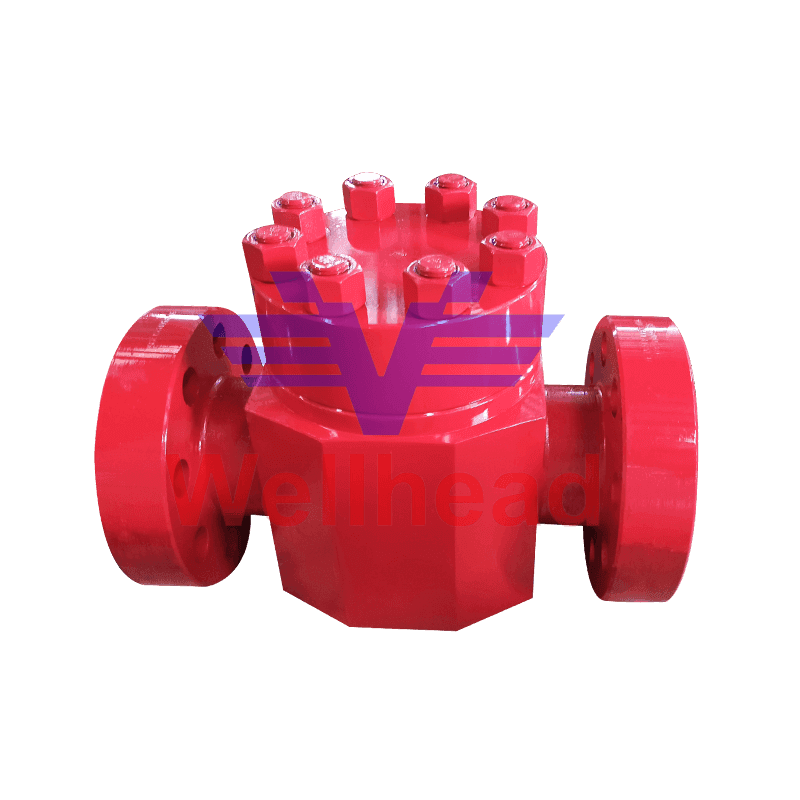 API 6A Lift Check Valve for Wellhead and Manifold GasGuided lift check valve for quick closure and high pressure in wellhead and manifold gas service; view for sealing and maintenance details.View Product →
Dart check valves use a dart-shaped poppet inside a cage, giving a straighter bore and a positive seal on reverse flow. They suit flowlines and manifold gas where you want a compact, serviceable non-return element, and they can be arranged so that disc position is monitored rather than guessed — useful when a line is remote and a passing valve would only be noticed at the meter.
 Dart Check Valve for Flowlines and Manifold GasCompact non-return valve with dart-shaped poppet and positive reverse-flow seal; view for flowline and manifold gas applications and monitoring options.View Product →
Swing, dual-plate wafer and ball types each have a place, but they behave differently in gas. The comparison below is the practical version.
| Type | Mounting | Best gas duty | Main limitation |
|---|---|---|---|
| Lift / piston | Vertical, flow up | High-pressure gas, wellhead, manifolds | Sensitive to solids; tight guide clearances |
| Dart / cage guided | Vertical or horizontal per design | Flowlines, manifold gas, remote lines | Cage can collect debris if gas is dirty |
| Swing | Horizontal | Large, low-velocity gas headers | Slow closing; prone to slam in fast gas |
| Dual-plate wafer | Horizontal or vertical | Compact distribution and skid piping | Short travel plus dirt equals seat damage |
| Ball | Any | Dirty or wet gas, utility lines | Ball rotation wears soft seats; modest shutoff |
Sizing and specification: the numbers that decide performance
Size the valve on gas velocity at the seat, not on nominal line size alone — an oversized check valve in a low-flow gas line spends its life half open and wears out early.
- Velocity and pressure drop: keep the valve's pressure loss inside the budget you have already given the regulator. A check valve that consumes 0.3 bar on a low-pressure fuel gas line is not a detail.
- Bore versus line size: a reduced bore is acceptable where pressure drop allows; a full bore costs more but keeps velocity and noise down.
- Pressure class: API 6A classes from 2,000 to 15,000 psi, or ASME classes 150 to 2,500 in plant piping. Specify the class, not "high pressure".
- Temperature class: gas temperature drives elastomer life more than pressure does. A seat rated 100 °C in a 120 °C line will harden and leak within months.
- Sour service: if H2S partial pressure exceeds the threshold in NACE MR0175, the wetted metallurgy and hardness must comply. This is a purchasing requirement, not a preference.
- Testing: hydrostatic shell test plus a seat leak test to API 598 or ISO 5208 is the minimum evidence you should ask for.
| Seat / seal material | Practical gas temperature | Good for | Watch out for |
|---|---|---|---|
| NBR | -30 to 100 °C | Sweet natural gas, general utility gas | Hardens with heat; swells with aromatic condensate |
| HNBR | -40 to 150 °C | Warmer gas, better mechanical strength | Higher cost; still limited with aggressive aromatics |
| FKM | -20 to 200 °C | Hydrocarbon-rich and aromatic gas streams | Poor low-temperature flexibility; check cold start-up |
| FFKM | up to 230 °C and above | Aggressive or hot gas where nothing else lasts | Expensive; long lead times |
| PTFE | -50 to 200 °C | Broad chemical resistance, low friction | Cold flow under load; needs proper seat support |
| Metal-to-metal | Very wide | High pressure, abrasive or extreme temperature gas | Cannot reach soft-seat tightness; expect a controlled leak rate |
Installation mistakes that shorten gas check valve life
Most gas check valve problems are installation problems, and they show up as chatter, leak-by or a disc that no longer moves.
- Wrong orientation. Lift and piston types generally want vertical up-flow. Fit one sideways and gravity becomes a wear force instead of a closing aid.
- Valve too large for the flow. A half-open disc flutters at high frequency and hammers the guide until the seat is out of shape.
- Trapped gas between two isolation valves. Thermal expansion raises pressure with nowhere to go; plan relief or choose a design that tolerates it.
- Construction debris. Weld slag and mill scale score the seat on the very first closure. Flush and, where possible, fit a temporary strainer upstream.
- Compressor pulsation. Pulsation excites the disc; a spring-loaded or damped valve is the usual cure, not a bigger valve.
- Hydrate formation. At pressure letdown in wet gas, hydrates can freeze a disc open or shut. Heat tracing and dehydration upstream matter more than the valve choice.
- Reinstalled backwards after maintenance. Check the flow arrow every time — this remains the most common cause of "faulty" returns.
Where gas check valves earn their place
In oil and gas, a gas check valve normally sits at the boundary between a system that flows and a system that must not flow backwards.
- Wellhead and flowline gas: protects the tubing and the upstream string from produced gas reversing into a lower-pressure path.
- Gas lift lines: keeps injection gas from backing into the supply header when a compressor trips.
- Fuel gas skids: stops gas migrating toward a stopped generator set or turbine.
- Compressor discharge: blocks reverse rotation and back-pressure on shutdown, which is why closing speed matters more here than leak class.
- Metering and regulating stations: protects meters from reverse pulses and keeps the measuring reference stable.
- Flare and vent headers: prevents header gas finding its way into a maintenance-isolated branch.
- Utility and dispenser piping: the everyday one-way duty seen in gas distribution and fuelling lines.
A short purchasing checklist
If you can answer these eight questions before you request a quote, the technical evaluation usually takes one exchange rather than three.
- What are the gas composition, H2S content and dew point?
- What is the operating pressure range and the required class?
- What is the minimum, normal and maximum flow — in actual volumetric terms?
- Is the line horizontal or vertical, and which way does flow run?
- Which leak class is acceptable, and how will it be tested?
- What is the temperature range, including start-up and depressurisation?
- Does the valve need to be serviceable in place, or is it a welded-in item?
- Which certification documents must accompany delivery?
Comparing shortlisted options against a full API 6A check valve range that includes both lift and dart designs usually settles the body-style question quickly, because the mounting orientation and the required leak class usually eliminate one of them.
Frequently asked questions
What is the difference between a check valve and a non-return valve?
Nothing functional — both describe a valve that permits flow in one direction only. "Non-return" is the more common term in European and process-industry documentation, while "check valve" dominates North American and oilfield usage.
Can a gas check valve be installed horizontally?
It depends on the type, not on preference. Swing and dual-plate designs are made for horizontal lines, and many dart designs work in either orientation, but lift and piston types normally require vertical up-flow so gravity assists closure instead of loading the guide.
What cracking pressure suits a low-flow gas line?
Use the lightest spring that still keeps the disc stable — often around 0.5 to 1 psi — and then verify that the valve still seats when flow stops. Too light a spring produces flutter; too heavy a spring means the valve never opens fully at low demand.
How do I get a genuinely tight shutoff on gas?
Specify a soft-seated design, a lapped seat face and a stated leak class such as API 598 or ISO 5208 rate A. Metal-seated valves are the right answer for high pressure, abrasive gas or extreme temperature, but they cannot match soft-seat tightness and should be accepted with a defined leak allowance.
When is NACE MR0175 compliance mandatory?
When the H2S partial pressure in the gas exceeds the standard's threshold, or when company specification requires it regardless. In those cases the metallurgy, hardness limits and documentation all change, so raise it at the enquiry stage rather than at inspection.
A gas check valve is a small item with an outsized effect on how safely a line behaves when a compressor stops, a valve is closed or a maintenance crew isolates a branch. Get the four numbers right — class, bore, cracking pressure and seal material — match the type to the mounting orientation, and state a testable leak class. The rest is detail that a competent supplier can close out in a single exchange.
 + 86-0515-88429333
 CONTACT US
