

 English
 русский
A kick becomes a blowout in minutes. Formation fluid enters the wellbore because formation pressure has edged above the hydrostatic pressure of the mud column, and from that moment the crew is working against a clock. The equipment standing in that gap is the blowout preventer, and the phrase "BOP blowout" really describes a single question: will the stack close and seal before the well wins?
Short answer: a blowout preventer stops a blowout by closing and sealing the wellbore on command — around the drill pipe with pipe rams, across an open hole with blind rams, around almost any shape with an annular element, or by shearing the pipe outright with shear rams. Choke and kill lines keep a controlled flow path open to surface so the crew can circulate kill-weight mud. The BOP contains the well; the mud weight kills it.
The failures that matter rarely come from the concept. They come from the wrong closure element for the pipe in the hole, elastomers that were never rated for the well temperature or H2S content, and pressure tests that never reproduced real shut-in conditions. The sections below work through type selection, stack arrangement, API 16A specification, and the procurement traps that surface after the purchase order is signed.
Content
- What a Blowout Preventer Is and What It Cannot Do
- Annular or Ram: Choosing the Closure Element
- Control Systems: Turning a Decision Into a Closed Ram
- Testing: Where Blowout Prevention Usually Fails First
- Specification Checklist: What to Confirm on an API 16A BOP
- Procurement Risks Buyers Learn the Hard Way
- Frequently Asked Questions
What a Blowout Preventer Is and What It Cannot Do
A blowout preventer is a high-pressure valve assembly flanged to the wellhead, designed to close and seal the wellbore on hydraulic or mechanical command; API 16A is the governing specification for drilling and well-servicing BOP equipment.
Mechanically, every BOP performs four jobs:
- Seals the bore around or across whatever is in the hole — drill pipe, casing, kelly, wireline, or nothing at all.
- Keeps a circulation path open through outlet spools and choke and kill lines, so the well can be circulated while it is shut in.
- Cuts the pipe when no sealing element can engage it, using shear rams.
- Holds pressure long enough for the crew to weight up mud, pump it down the string, and kill the well.
What it cannot do is remove the cause of the kick. A BOP that closes perfectly still leaves the wellbore pressured up, and the reservoir is controlled by mud weight and the circulation schedule that follows. Treating the stack as a killing tool rather than a containment tool remains one of the most persistent misconceptions in well control.
Stack location also shapes the design. A surface stack sits above the rotary table, where rams can be changed and inspected on the rig floor. A subsea stack sits on the seabed inside a frame, adds a marine riser disconnect and redundant control pods, and makes every elastomer change a vessel-based operation. The closure logic is the same; the maintenance economics are not.
Annular or Ram: Choosing the Closure Element
Choose the closure element by the pipe in the hole and the pressure it must hold, not by what happens to be on the shelf.
Annular preventers close around anything — pipe, casing, kelly or open hole — because a hydraulic piston squeezes an elastomeric element inward and the element conforms to whatever it meets. That flexibility costs working pressure and narrows the temperature window. Ram preventers trade the flexibility for higher working pressure and a fixed sealing geometry, which is why most stacks carry both.
| Closure element | What it seals | Pipe movement | Typical working pressure | Field notes |
|---|---|---|---|---|
| Annular | Pipe, casing, kelly or open hole | Tolerates slow movement; supports stripping | 5,000–10,000 psi | Widest tolerance, narrowest elastomer and temperature window |
| Pipe ram | One specific pipe outside diameter | Pipe must be stationary and centred | 10,000–15,000 psi | Fixed bore; variable-bore rams cover only a small OD range |
| Blind ram | Open hole with no pipe | None | 10,000–15,000 psi | Cannot close on pipe; frequently paired with a shear ram |
| Shear ram | Cuts the pipe, then seals the bore | None; the pipe is destroyed | 10,000–15,000 psi | Shear force must match pipe grade and wall thickness |
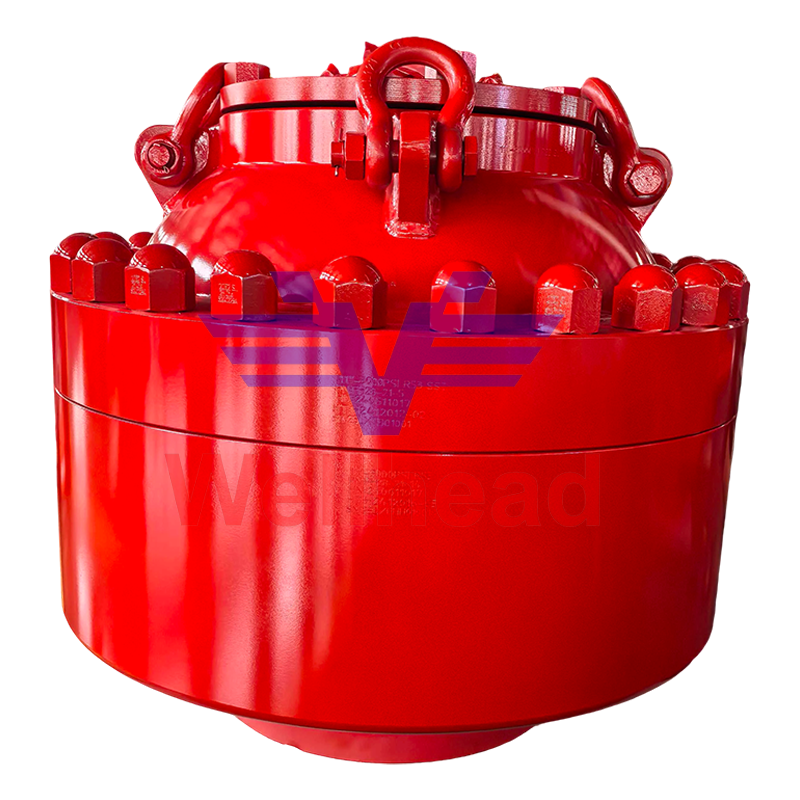 API 16A Annular Blowout Preventer for Well ControlAnnular BOP for API 16A well-control stacks; its flexible element closes around pipe, casing, kelly or open hole.View Product →
A working surface stack typically reads, from the wellhead upward: drilling spool with choke and kill outlets, one or two ram cavities (pipe plus blind or shear), then the annular on top. The annular goes last because it is the most tolerant element and the one you want available when pipe is moving or the string is not centred.
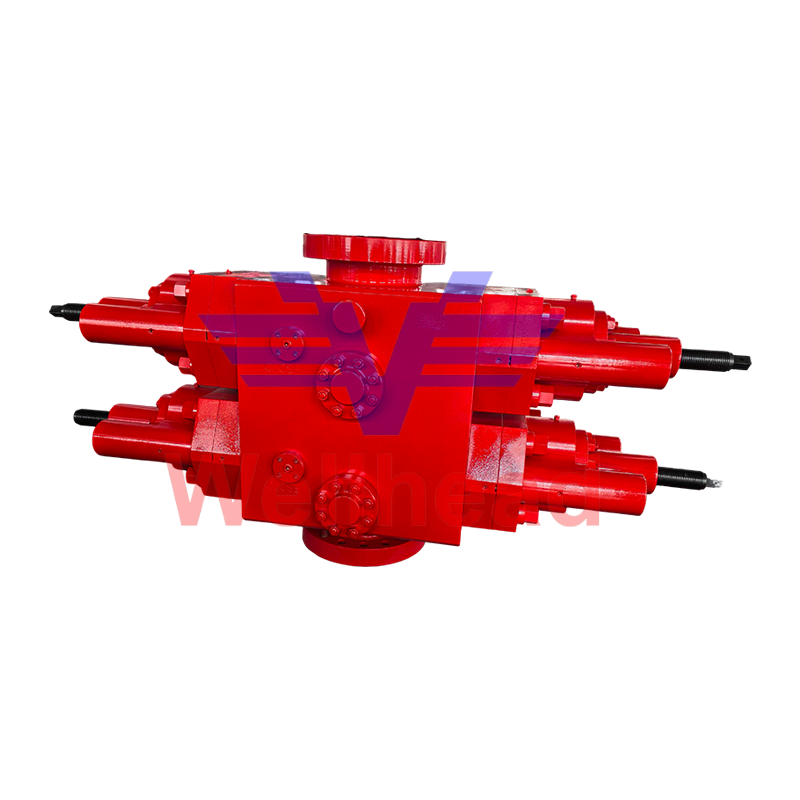 API 16A Double Ram Blowout Preventer for Well ControlDouble ram BOP for wellhead sealing, with two rams closing around pipe or casing to form a barrier during abnormal pressure.View Product →
Two sizing mistakes recur. The first is selecting a ram bore for the drill pipe only, forgetting that casing, a kelly or a wireline tool may be in the hole when the well needs closing. The second is stacking 10,000 psi cavities under a 5,000 psi annular and assuming the assembly is rated to the lower number throughout — the wellhead, spool and manifold each carry their own rating, and the weakest component sets the limit for the whole pressure envelope.
Control Systems: Turning a Decision Into a Closed Ram
Every closure element depends on stored hydraulic energy, so the control system matters as much as the iron.
Accumulator bottles, control pods, pilot lines and the operator panel convert a decision into a closed ram in seconds. Modern single-ram BOP control has moved toward intuitive operator interfaces with ram position feedback, manifold pressure readouts and sequenced closing logic, which shortens the distance between recognising a kick and shutting the well in. The practical details are covered in this note on single-ram BOP remote operation. Whatever the interface, verify closing time and accumulator capacity against the control system requirements for your stack, and confirm that failsafe means close, not hold.
Hydraulic fluid condition is the quiet variable. Contaminated fluid slows piston travel, and slow travel reads as a control failure during a function test rather than during a kick, which is the only good time to find it.
Testing: Where Blowout Prevention Usually Fails First
Most BOP faults are found during testing, not during a kick, which is precisely why the test programme outweighs the datasheet.
Two tests answer two different questions. Function testing proves the ram travels and the control system responds; pressure testing proves the seal holds at working pressure. Common practice, following API Standard 53 and operator policy, is to pressure test the stack when it is installed, after any ram or seal change, after a shear test, and on a cycle that typically does not exceed 21 days, with function tests performed each trip or at least weekly.
The tool that makes pressure testing practical on a rig floor is the test stump. It runs in on drill pipe, seals inside the bore below the cavity being tested, and allows pressure to be applied from underneath, so each ram cavity, the annular and the outlet connections can be verified independently without pulling the string.
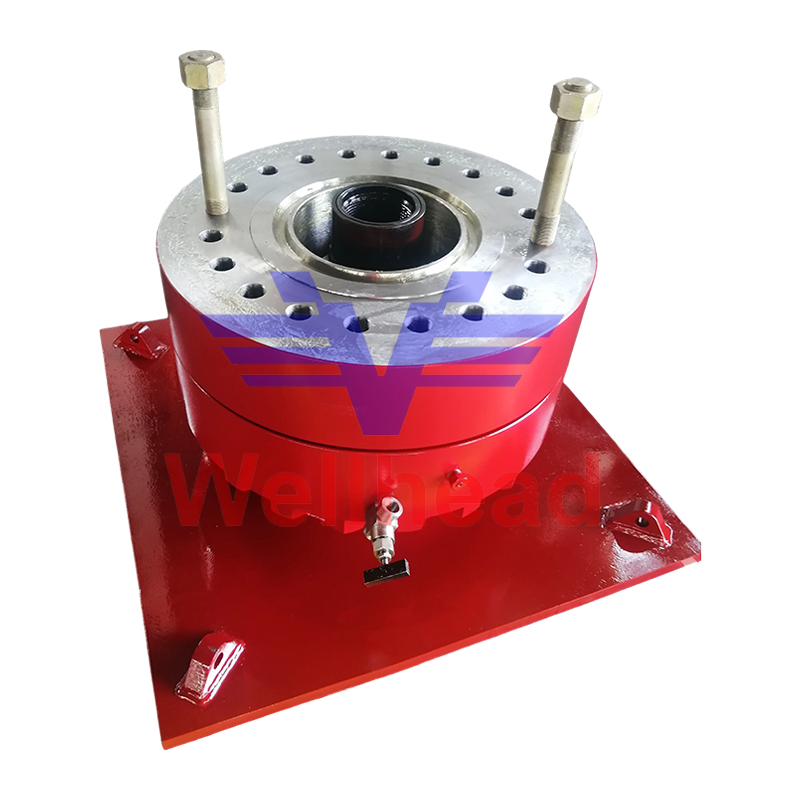 API 16A BOP Test Stump for Pressure TestingTest stump that seals inside the bore below a ram cavity, allowing independent pressure testing of BOP cavities, annular and outlet connections.View Product →
Record what was tested, at what pressure, for how long, and with what fluid. A test chart that shows the same pressure held on every cavity regardless of rating tends to collapse under audit, and it tells the next crew nothing about where the seal actually is.
Specification Checklist: What to Confirm on an API 16A BOP
Two preventers with the same bore and pressure rating can be very different pieces of equipment, so confirm these parameters before comparing quotations.
| Parameter | What to confirm | Typical options | Why it matters |
|---|---|---|---|
| Working pressure | Maximum anticipated shut-in pressure plus margin | 3,000 / 5,000 / 10,000 / 15,000 psi | An undersized stack leaves no margin for a gas kick |
| Temperature class | Well fluid and ambient range at the rig | P, U, T and other classes | Outside the class, elastomers harden, crack or extrude |
| Product Specification Level | Documentation and quality rigor | PSL 1 to PSL 4 | PSL 3 and 4 are expected in critical and sour service |
| Performance requirement | Design validation testing | PR1, PR2 | PR2 covers validation at pressure and temperature extremes |
| Outlets and flanges | Match to wellhead, choke and kill manifolds | API 6B and 6BX studded or flanged outlets | Mismatch leads to field fabrication and extra leak paths |
| Sour service | NACE MR0175 compliance for H2S | Yes or no | Sulphide stress cracking gives no warning before it fails |
Procurement Risks Buyers Learn the Hard Way
Most unpleasant surprises on a BOP order are commercial and dimensional rather than metallurgical. These are the ones worth writing into the specification:
- Rating stacking. A high-pressure annular on a low-pressure spool, or vice versa, produces an assembly that can only be used at the lowest number.
- Elastomer substitution. Nitrile, hydrogenated nitrile, fluoroelastomer and polytetrafluoroethylene-based seals behave differently at low temperature and in sour gas; the cheapest compound that passes the test can still fail in service.
- Documentation gaps. Material certificates, heat numbers, pressure test charts and traceability are the difference between a stack that can be recertified and one that cannot.
- Spare rams and seals. Availability of the exact ram bore and seal kit after commissioning is a maintenance question, not a purchasing one.
- Lead time. Forged bodies, machining and monogram witnessing dominate delivery; a rush order usually means an existing body, not a faster process.
Sourcing therefore comes down to documentation discipline and machining capability. Jiangsu Wellhead Drilling Equipment manufactures API 16A annular, single-ram and double-ram BOPs, 16C choke and kill manifolds, test stumps and high-pressure fittings at its Yancheng facility in Jiangsu, China — a 70,000 m² site with CNC machining, automated welding and automated painting, holding API Q1, API 6A, API 16A and API 16C monogram licences alongside ABS, BV and CCS classification approvals and ISO 9001, 14001 and 45001 certification. The company is listed as a supplier to CNPC, SINOPEC and CNOOC, which means its paperwork trail is already structured around state oil company material and test requirements. On a rig waiting for a certified stack, that trail matters more than a brochure.
Frequently Asked Questions
Can a BOP stop a blowout on its own?
No. It seals the wellbore and holds pressure, but the well is only killed when mud weight exceeds formation pressure and circulation removes the influx. The BOP buys the time to make that happen.
Should the annular or the rams close first?
There is no universal answer. Many operators use the annular for initial shut-in or stripping when pipe is moving, and rely on rams for a hard seal at full working pressure. The sequence belongs in the well control procedure and should be fixed before the well spuds.
How often should a BOP be pressure tested?
Common practice is after installation, after any ram or seal change, after a shear test, and on a cycle that generally does not exceed 21 days, with function tests every trip or at least weekly. Local regulation and operator policy override any general number.
What working pressure should I specify?
Start from the maximum anticipated surface shut-in pressure, add a margin, then make sure the wellhead, spool, BOP and manifold all carry ratings that match. Mixed ratings quietly reduce the whole assembly to its weakest part.
What causes most BOP seal failures in service?
Elastomer selection and mechanical damage. Seals that see temperatures or H2S concentrations outside their class age fast, and a ram closed on the wrong pipe outside diameter can tear a sealing element on the first actuation.
Blowout prevention comes down to three things that can all be verified before the rig moves: the right closure element for the pipe and the pressure, a control system that closes reliably from the panel, and a test programme that reproduces real shut-in conditions. Everything else — the monogram, the lead time, the spare ram set — supports those three. Get the stack configuration and the specification checklist right, and the BOP does the one job it exists for: it holds the well long enough for the mud weight to win.
 + 86-0515-88429333




 CONTACT US
