

 English
 русский

BOP hydraulics is the stored energy, fluid and control path that actually drives a blowout preventer's sealing element against wellbore pressure. When the accumulator volume, closing ratio and line sizing are wrong, a stack can pass every shell test on the certificate and still close too slowly, or close without sealing, during a real kick.
The practical answer first: size accumulators from the true displacement volume of every function on the stack, verify the closing ratio at the highest shut-in pressure you expect, and measure closure time on the installed unit instead of trusting a datasheet. Everything else in this article explains why those three numbers matter and how they interact.
Content
- What BOP Hydraulics Actually Covers
- Direct, Pilot-Operated and Subsea Control
- Closing Ratio: The Number That Decides Whether a Ram Seals
- Accumulator Sizing and Usable Fluid Volume
- Response Time: What the Rig Floor Actually Feels
- Hydraulic Fluid, Cleanliness and Cold Weather
- When a BOP Fails to Close: Reading the Symptom
- Matching BOP Hardware to Your Hydraulic Supply
- Frequently Asked Questions
What BOP Hydraulics Actually Covers
BOP hydraulics is a closed power loop with four parts, and all four have to be sized together. The system stores energy, generates pressure, distributes flow and converts that flow into mechanical force on the preventer.
- Energy storage: nitrogen-precharged accumulator bottles, normally the only source of energy during a power failure.
- Pressure generation: closing unit pumps and regulators that recharge the bottles and hold system pressure.
- Distribution: manifolds, control valves, regulators, panels and hydraulic lines down to each function.
- Actuation: the operating cylinders on annular preventers and ram preventers, plus the locking screws on units that have them.
A useful way to think about it: the system must deliver a defined volume, at a defined pressure, within a defined time, at the moment the rig has already lost power and instrument air. Every design decision should be judged against that single scenario.
Direct, Pilot-Operated and Subsea Control
Surface stacks almost always use pilot hydraulic control, because it keeps the high-pressure lines short and moves only a small pilot volume to the remote panel. Direct hydraulic control is simpler and slower, and is now mostly found on small workover units.
Why subsea systems look different
Subsea stacks use indirect hydraulic control, where pilot pressure travels down an umbilical to subsea control pods and sequence valves that admit fluid from local accumulator bottles. The reason is distance: pushing full actuation volume through several hundred metres of hose would be too slow and would lose too much pressure to friction. Subsea response also has to account for hydrostatic head, so a function that closes in seconds on land may need a longer allowance offshore.
Closing Ratio: The Number That Decides Whether a Ram Seals
Closing ratio is the relationship between the wellbore pressure a preventer must hold and the hydraulic pressure required to close it, and it is the single most useful hydraulic figure in the whole stack. In practice the ratio is roughly the wellbore pressure divided by the hydraulic operating pressure available at the cylinder, after allowing for line losses and seal friction.
A simple example: with 10,000 psi shut-in pressure and 1,500 psi at the ram cylinder, the working ratio is about 6.7:1. If friction and line losses eat 200 psi of that, the effective ratio drops and the ram may reach the pipe without fully sealing. That is why operators keep cylinder pressure near the top of the manufacturer's band rather than the minimum, and why undersized control lines are a genuine well-control hazard rather than an inconvenience.
| Function | Hydraulic operating pressure | Typical closing ratio | What it means at the wellbore |
|---|---|---|---|
| Pipe ram | 1,500 to 3,000 psi | About 5:1 to 10:1 | Seals reliably at rated pressure only if full cylinder pressure arrives quickly |
| Blind or shear ram | Higher end of the range | Lower effective ratio | Needs extra pressure to shear pipe before sealing |
| Annular preventer | 1,500 to 3,000 psi | Lower ratio, larger piston area | Seals across a wide pipe or tool range but consumes more fluid per stroke |
Annulars deserve a separate note: because the element must squeeze across everything from drill pipe to kelly, the hydraulic demand is a volume problem as much as a pressure problem. The sealing behaviour of the element itself is covered in more detail in this look at annular BOP sealing performance.
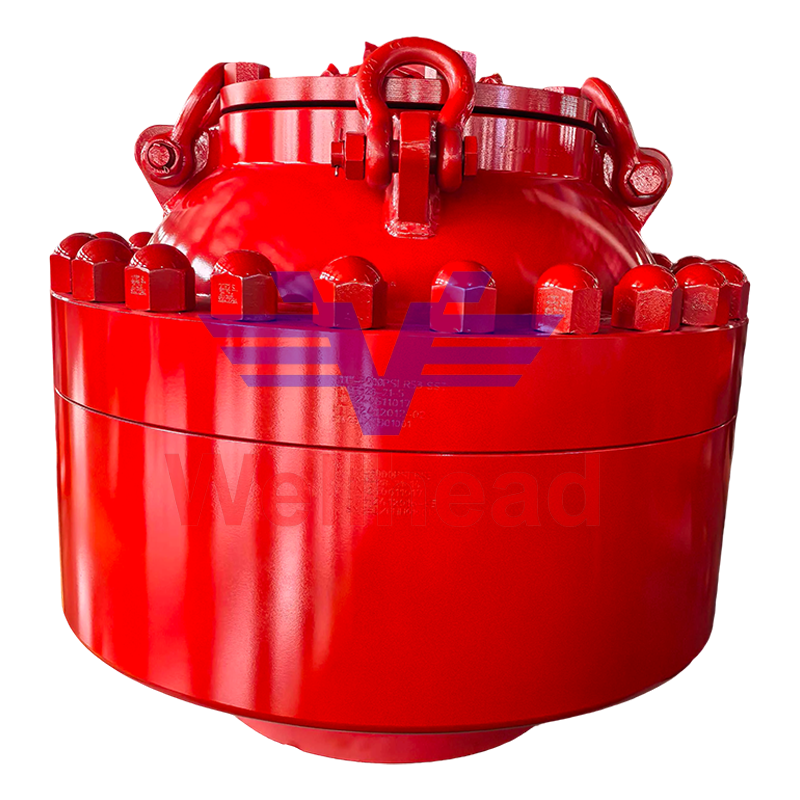 Annular BOPJIANGSU WELLHEAD DRILLING EUIPMENT CO., LTD. was founded in February 2005 and is a national high-tech manufacturing enterprise that integrates R&D, production, sales, ...View Product →
Accumulator Sizing and Usable Fluid Volume
Accumulator volume is set by the number of functions you intend to close in sequence, not by the physical size of the closing unit skid. The common failure is to count bottles rather than usable fluid.
API 16D-based practice is a reasonable anchor: usable fluid should be at least 1.5 times the total displacement volume of all functions to be operated from the accumulator, with additional allowance for the control system itself. Usable fluid is what remains after precharge and after the minimum pressure needed to hold a function closed, so it is always well below nominal bottle volume.
- Precharge is normally around 1,000 psi nitrogen on a 3,000 psi system, checked with pumps stopped and fluid drained from the bottles.
- Calculate displacement per function from the manufacturer's closing volume, then multiply by the number of operations you want available without recharging.
- Add the annular, because a single annular close can consume more fluid than three ram strokes.
- Confirm pump capacity can recharge the bottles in a realistic time, including one pump out of service.
3,000 psi
Common minimum system operating pressure for surface BOP control units.
1.5x
Usable accumulator fluid versus total displacement of all operated functions.
1,000 psi
Typical nitrogen precharge on a 3,000 psi accumulator bank.
30 seconds
Ordinary closure target for surface ram functions; larger bores and cold fluid need longer.
Response Time: What the Rig Floor Actually Feels
Response time is a plumbing problem more than a pressure problem. Long, narrow lines and cold, viscous fluid cost more seconds than a slightly undersized bottle bank, and they are far harder to diagnose afterwards.
| Function | Typical target | Usual bottleneck |
|---|---|---|
| Annular close | 30 seconds or less | Large fill volume, cold fluid, restricted return line |
| Pipe ram close | 30 seconds or less | Line internal diameter, sequence valve setting, fittings |
| Shear ram close | Often 30 to 45 seconds | Pressure required to shear, plus volume to complete the seal |
| Ram open | 30 seconds or less | Back pressure and return flow, not supply pressure |
Measure response on the installed stack with a pressure recorder, at realistic ambient temperature, with one function at a time and then with the worst-case sequence. Testing hardware makes that repeatable rather than anecdotal.
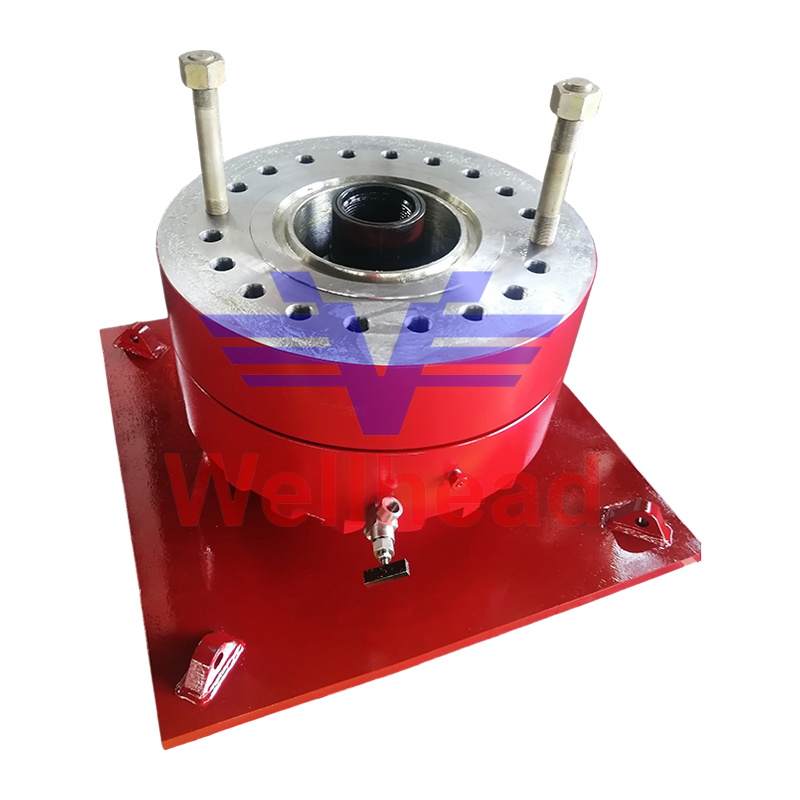 BOP Test Stump for High-Pressure Well ControlA high-pressure sealing and blowout-prevention test stump with remote monitoring, relevant when checking installed-stack response before attributing slow closure to fluid condition.View Product →
Hydraulic Fluid, Cleanliness and Cold Weather
Fluid choice matters far less than fluid condition. Most slow-closing complaints trace back to water contamination, aeration or the wrong viscosity at ambient temperature, not to the base stock on the label.
- Water-based fluid with a corrosion inhibitor and 3 to 5 percent lubricant is the common default where leakage to the environment matters.
- Glycol blends hold viscosity better in sub-zero conditions; mineral oil is used where the specification allows it.
- Target ISO 4406 cleanliness around 18/16/13 or better, with 10 micron absolute filtration on the fill and transfer path.
- Sample the fluid at least twice a year and after any contamination event, and never top up with a different base stock.
When a BOP Fails to Close: Reading the Symptom
If a function closes slowly once and then behaves normally, suspect air; if it degrades steadily over weeks, suspect fluid loss, internal leakage or seal wear. The symptom pattern usually identifies the cause faster than a pressure gauge does.
| Symptom | Probable cause | First check |
|---|---|---|
| Slow close on every function | Low precharge or low system pressure | Bottle precharge with pumps stopped |
| One function slow, others normal | Restricted line, valve or regulator for that circuit | Pressure at the cylinder versus at the manifold |
| Ram closes but will not hold pressure | Insufficient closing ratio or worn sealing element | Closure pressure and element condition |
| Pressure decays after closure | Internal leakage in a control valve | Isolate the circuit and watch the gauge |
Remember that hydraulics and the pressure-control loop work as a pair. The choke manifold has to take the flow the preventer diverts, and a slow-acting choke turns a controlled kick into a pressure spike even when the BOP itself performed correctly.
Matching BOP Hardware to Your Hydraulic Supply
The cheapest place to fix a hydraulic mismatch is the specification stage, while bore, operating pressure and cylinder displacement are still negotiable. Retrofitting a closing unit after delivery is always the expensive route.
- Confirm operating pressure and displacement volume for every ram and annular size you intend to run.
- Decide whether you need hydraulic locking, manual locking screws, or both, and confirm how each affects closing volume.
- Confirm API 16A hardware documentation and API 16D control system compatibility in the same package.
- Confirm port sizes, connection types and line lengths match the closing unit, then calculate friction loss at peak flow.
- Run a function test at minimum ambient temperature before acceptance, not after.
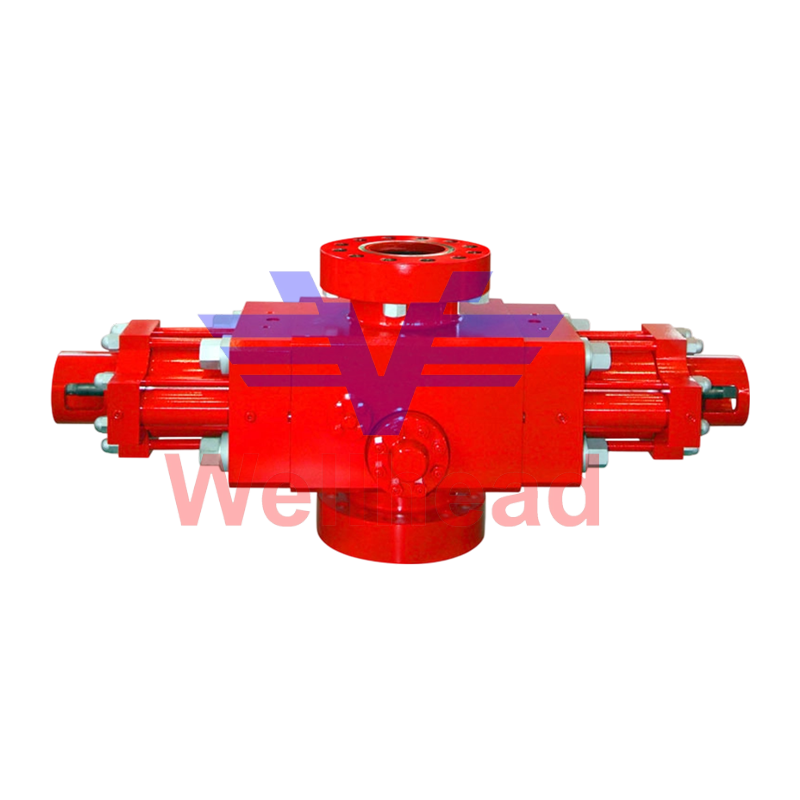
For stacked configurations, a double ram body is often the practical choice because it gives blind and pipe closure in one flanged envelope and reduces the number of hydraulic circuits that have to be routed and tested.
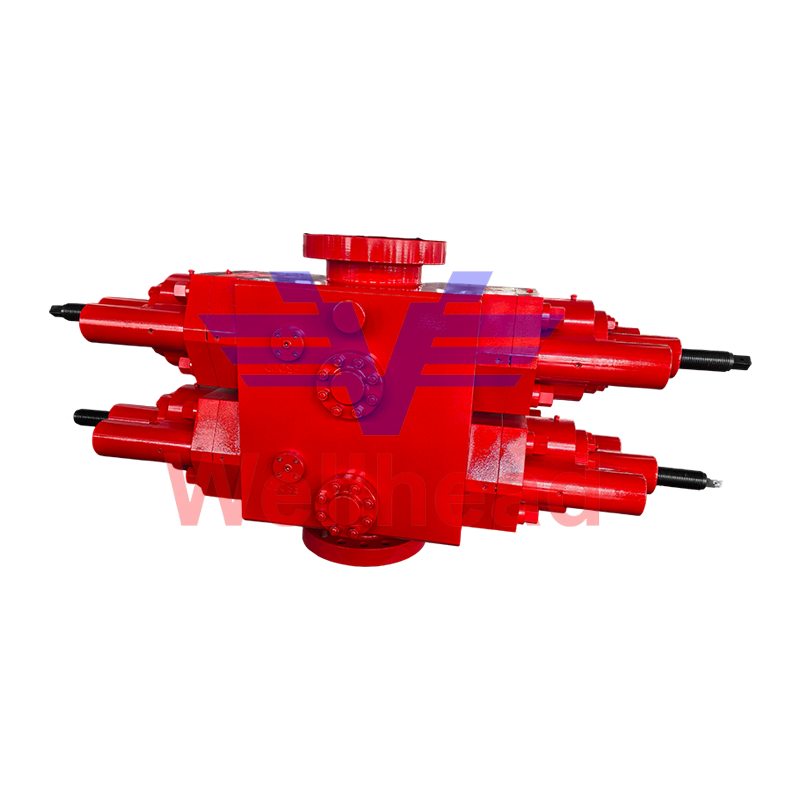 Double Ram Blowout Preventer for Drilling Well ControlA dual-ram wellhead sealing device offering blind and pipe closure in one flanged body, with API 6A/NACE materials for high-pressure drilling operations.View Product →
Frequently Asked Questions
What should accumulator bottles be precharged to?
Around 1,000 psi nitrogen on a 3,000 psi system is the usual starting point, checked with the pumps stopped and the fluid drained from the bottles. Higher pressure systems use a higher precharge, and the manufacturer's chart always governs.
How much hydraulic pressure does it take to close a ram?
Typically 1,500 to 3,000 psi at the cylinder for surface units, plus an allowance for line friction. The exact figure follows from the closing ratio at your maximum anticipated shut-in pressure, and it should never exceed the manufacturer's rated operating pressure.
Can a BOP be closed without hydraulic power?
Yes, using manual locking screws or a hand pump on smaller units, but it is slow and should be treated as an emergency backup rather than a design assumption. Accumulator capacity exists precisely so that stored energy covers the first critical closure.
Why does the annular close slowly in cold weather?
Viscosity. Cold fluid resists flow through narrow lines and fittings, so the cylinder fills more slowly. A glycol-blend fluid and correctly sized lines usually solve it; increasing pump pressure does not.
How often should the hydraulic fluid be tested?
At least twice a year, and immediately after any contamination event, fluid change or major repair. Particle count and water content are the two results worth tracking over time.
 + 86-0515-88429333

 CONTACT US
