

 English
 русский

Check valves for oil service are selected in a deliberate order: the fluid and the cost of reverse flow come first, then the design, then the pressure class, trim and seals, and finally the test documentation. Skip a step and the valve usually fails quietly, with a chattering disc, a weeping seat and a shutdown to replace a part that should have lasted a decade.
A check valve, also called a non-return valve, is an automatic one-way device. Forward differential pressure lifts the disc or dart off its seat; when flow stops or reverses, spring force, gravity or both push it back. There is no actuator, no solenoid and no control loop, which is exactly why the specification has to be right the first time.
Oilfield duty is unkind in specific ways: sand-laden production, H2S and CO2, pressure spikes during fracturing or well shut-in, and long idle periods followed by sudden high-rate flow. Those conditions, not the purchase price, decide which design survives.
Content
- What a Check Valve Does in an Oil Service Line
- Lift or Dart: Matching the Design to the Line
- Specifications That Decide Whether the Valve Lasts
- Where Check Valves Sit in an Oil Field
- Failure Modes You Will Actually See
- Installation, Testing and Maintenance
- What to Put in the Purchase Requisition
- Frequently Asked Questions
- The Bottom Line on Check Valves for Oil
What a Check Valve Does in an Oil Service Line
In oilfield terms, a check valve is a passive barrier against reverse flow, and it is judged on three numbers: cracking pressure, pressure class and allowable seat leakage.
Cracking pressure is the differential needed to open the valve. Too high, and the pump pays for it in lost head and cavitation risk. Too low, and the disc floats, chatters and hammers its own seat. Pressure class sets wall thickness and flange pattern; the leakage acceptance criterion sets what "closed" is allowed to mean on a test stand.
A well-chosen valve does three jobs at once:
- It protects upstream equipment such as pumps, meters and compressors from reverse flow and surge.
- It holds a barrier when a line is depressurized, so process fluid cannot migrate back into a lower-rated section.
- It closes fast enough to limit backflow but softly enough to avoid water hammer in a long flowline.
Lift or Dart: Matching the Design to the Line
Choose a lift check valve when flow runs vertically upward and cracking pressure must stay very low; choose a dart check valve when the line runs in any orientation, the fluid is dirty, or the valve has to be serviced without cutting pipe.
Lift check valves guide a disc or piston above the seat. Gravity assists closing, so they expect vertical up-flow; installed horizontally or on a downward run, they leak and chatter. Their strength is a very low opening differential and low pressure drop at full flow, which suits pump discharge and vertical wellhead flow paths.
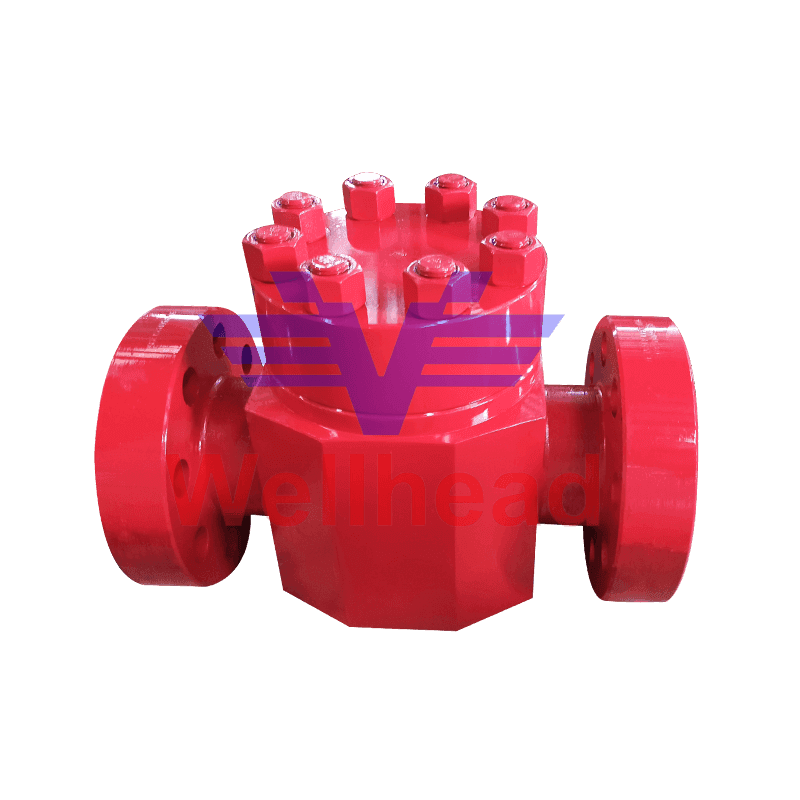 API 6A Lift Check ValveAPI 6A lift check valve for high-pressure oil and gas service, with zero-leakage sealing and modular design for maintenance in demanding wellhead and pipeline applications.View Product →
Dart check valves use a spring-loaded poppet with a defined travel. The spring lets the valve work in horizontal, vertical and inclined lines, and the dart tends to lift off the seat rather than trap debris on it. In exchange, the spring adds a small pressure drop, and cracking pressure has to be selected rather than inherited from the line.
 API 6A Dart Check ValveAPI 6A dart check valve for corrosive and high-temperature fluid service, with sealing, low-resistance flow and customizable materials, sizes and connections.View Product →
| Feature | Lift check valve | Dart check valve |
|---|---|---|
| Flow direction | Vertical up-flow only; gravity assists closing | Any orientation; spring returns the dart |
| Cracking pressure | Very low, often below 1 psi equivalent head | Set by spring, normally higher and tunable |
| Contamination tolerance | Poor; particles on the seat cause leakage | Better; the dart lifts clear and wipes debris |
| Service access | Seat replaced on the bench | Dart, spring and seat often replaced in line |
| Typical location | Pump discharge, vertical headers, wellhead flow paths | Kill lines, manifolds, flowlines, cementing and frac spreads |
| Pressure drop when open | Low | Slightly higher because of the spring |
Specifications That Decide Whether the Valve Lasts
Most check valve failures in oil service trace back to four specification choices rather than machining defects: material class, temperature class, product specification level and cracking pressure.
- Material class. Sour service changes everything. Where H2S partial pressure crosses the NACE MR0175 threshold, body, trim and bolting must be specified for it, typically DD or EE class in API 6A terms. Standard carbon steel trim in that service cracks rather than wears.
- Pressure class and PSL. API 6A classes from 2,000 to 15,000 psi are routine. PSL 2 or 3 adds non-destructive examination, hardness verification and full traceability, and PR2 validation is worth requesting where thermal cycling is expected.
- Temperature class. Class P covers roughly -20 to 180 degrees F, with higher letters for hotter service, but the elastomer usually sets the real limit, not the metal.
- Seat and seal material. PTFE and PEEK seats resist sand and many chemicals; HNBR suits sweet service; FKM handles aromatics but can suffer explosive decompression during fast gas depressurization. Match the seal to the gas, not to the catalogue page.
- Cracking pressure and flow coefficient. Size on the minimum sustained flow, not the maximum. An oversized valve runs partly open, wears the seat and hammers.
- End connections and testing. Flanged per API 6A, hammer union or threaded; state the hydrostatic and seat test you expect, and whether a gas test is required.
Projects that need both families usually benefit from buying them from one qualified source. Our API 6A check valve range shares one documentation set, so material certificates, test reports and spare kits stay consistent across a package.
Where Check Valves Sit in an Oil Field
Six locations account for most check valve applications on an oil asset, and each one imposes its own priorities.
- Drilling and kill lines. Dart valves stop well fluid from backing into the pump and mud system when a well kicks.
- Wellhead and flowline. Lift valves on vertical runs protect downstream piping from reverse flow during shut-in.
- Choke and kill manifolds. Check valves inside the skid prevent cross-feeding between pressure sources.
- Pump discharge. Low cracking pressure keeps efficiency high and limits cavitation damage.
- Tank and transfer lines. Simple, robust valves prevent back-mixing of product grades.
- Fracturing and cementing spreads. High-rate, sand-laden service makes hardened trim and clean seats essential.
A kill manifold is a good illustration: dart-style check valves sit alongside gate valves and adjustable chokes on one skid, so the check valve must be serviceable while the manifold stays assembled.
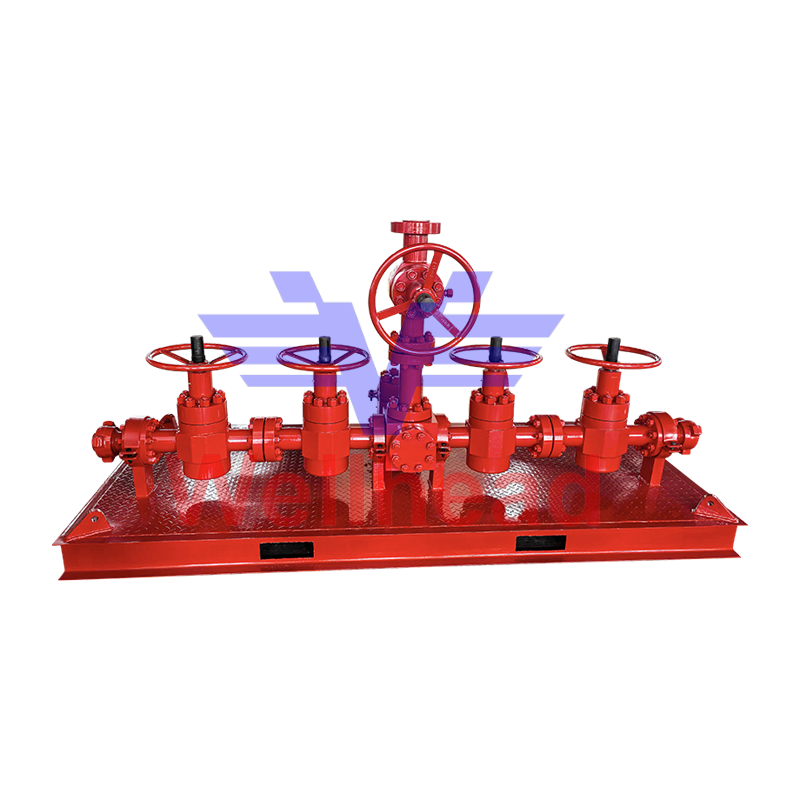 API 16C Kill Manifold for Well ControlAPI 16C kill manifold for high-pressure well-control operations, delivering killing fluid through a closed circulation system with gate valves, chokes and corrosion-resistant forged construction.View Product →
Failure Modes You Will Actually See
Five patterns explain most check valve problems in oilfield service, and each has a countermeasure that costs far less than the downtime it prevents.
| Symptom | Usual cause | Practical fix |
|---|---|---|
| Chatter or hammering | Valve oversized for actual flow, or wrong spring | Size on minimum flow; match spring to the line |
| Seat leakage on test | Debris, scale, wire drawing from partial opening | Flush and filter upstream; replace seat insert |
| Erosion of dart or disc | Sand-laden, high-velocity flow | Hardened trim; review velocity and differential |
| Valve held open | Wax, hydrate or scale bridging the seat | Chemical programme, heat trace, shorter inspection interval |
| Seal swelling or cracking | Wrong elastomer, gas decompression damage | Switch to PEEK or PTFE seats, or a suited elastomer |
Installation, Testing and Maintenance
A check valve installed with the correct flow arrow, a flushed line and a recorded seat test will outlast an identical valve bolted in during a hurry.
- Confirm orientation and spring choice before makeup; lift designs need true vertical up-flow.
- Flush the upstream line before first flow. Welding slag and mill scale destroy a seat in minutes.
- Torque to specification, fit the correct gasket and avoid piping strain on the body.
- Record baseline seat test pressure at commissioning so later readings mean something.
- Pull and inspect at planned shutdowns, and keep seat and spring kits in stock, since lead time is the real cost of a failure.
- For gas service, equalize pressure across the valve before disassembly.
What to Put in the Purchase Requisition
A clear requisition prevents more failures than a firm conversation after delivery.
- Design, size, pressure class, PSL, material class and temperature class.
- Required cracking pressure and flow coefficient at the operating rate.
- End connections, face-to-face dimension and flow orientation.
- Seat and trim material, plus the sour service standard that applies.
- Test standard and certificate type: hydrostatic, seat and gas test.
- Traceability documents, spare kits and stated lead time.
Frequently Asked Questions
Is a check valve the same as a non-return valve?
Yes. Check valve, non-return valve and one-way valve describe the same automatic device; only the regional naming differs.
Can a check valve be installed horizontally?
It depends on the design. Spring-loaded dart valves work in any orientation, while lift and swing designs that rely on gravity need vertical up-flow to seat reliably.
What cracking pressure should I specify?
As low as the application allows without inducing chatter. Many liquid lines use a very light spring, while high-rate or pulsing service needs a firmer spring and a valve sized on minimum flow rather than line size.
Do I need NACE-compliant material for sour oil?
Yes, once the H2S partial pressure exceeds the NACE MR0175 threshold. Standard trim in that service fails by cracking, not by gradual wear, so the failure is sudden.
How can I tell when the valve is closed?
Passive valves give no signal by themselves, and that limit is worth understanding before adding instrumentation. Our field note on dart check valve control options explains what indication can realistically achieve.
How often should check valves be inspected?
At every planned shutdown, with a seat test at least annually in sand-prone or high-cycle service, and sooner after any event that produced reverse flow or pressure surge.
The Bottom Line on Check Valves for Oil
Start with the fluid and the consequence of reverse flow, then pick lift for vertical low-differential duty and dart for everything dirty, angled or serviceable in line. Fix material class, temperature class, PSL and cracking pressure before price is discussed, and put the test documentation in the requisition. A check valve has no instruments to warn you, so the specification and the installation record are the only early warnings you get.
 + 86-0515-88429333
 CONTACT US
