

 English
 русский
API 6A valves are pressure-control valves manufactured to API Specification 6A for wellhead and Christmas tree service, providing the isolation, throttling, and emergency shutdown functions that keep oil and gas wells safe. The short procurement answer is this: choose an API 6A valve whose rated working pressure is at or above your maximum shut-in pressure, whose material and temperature classes match the fluid and operating environment, and whose PSL level fits the criticality of the service. The sections below turn that answer into a practical selection and maintenance framework.
For operators, engineers, and purchasing teams comparing API 6A valves, this guide covers the structure of the specification, the valve families you will encounter, the differences between API 6A and API 6D, and the decisions that determine whether a valve performs reliably for the life of the well.
Content
What API Specification 6A Defines
API Specification 6A is the industry's governing standard for wellhead and Christmas tree equipment, so the 6A designation is the first quality benchmark a buyer should check when sourcing wellhead valves.
The specification defines the complete surface pressure boundary, not just the valves:
- Gate valves
- Check valves
- Choke valves
- Safety valves and actuators
- Casing heads, tubing heads, connectors, spools, and adapters
- Test equipment and pressure-containing accessories
API 6A organizes its requirements into five product specification levels (PSL 1, 2, 3, 3G, and 4), two performance requirement levels (PR1 and PR2), eight temperature classes, six material classes, and six standard pressure ratings.
A manufacturer must also operate an API Q1 quality-management system and hold a valid API 6A monogram license before it can mark a valve with the API 6A designation. That is what separates a certified wellhead valve from an industrial valve that merely looks similar.
Main Types of API 6A Valves
API 6A valves fall into four functional families — gate, check, choke, and safety valves — and each family solves a distinct wellbore control problem.
Gate Valves
Gate valves are the primary isolation valves on a wellhead, providing full-bore, bi-directional shutoff of tubing and casing flow.
- FC flat gate valves — slab-gate design for general production and injection service.
- FL flat gate valves — lip-seal design that lowers operating torque and improves leak-tightness.
- FLS flat gate valves — sealant-injection ports that can restore sealing on slightly worn seats.
- FLSR ball-screw gate valves — recirculating ball screw for low-torque operation on large-bore valves.
- Expanding gate valves — mechanically expanded gates for a positive metal-to-metal seal in gas service.
- Mud gate valves (YMF, OTECO, DM types) — hardened trims for abrasive drilling-mud lines.
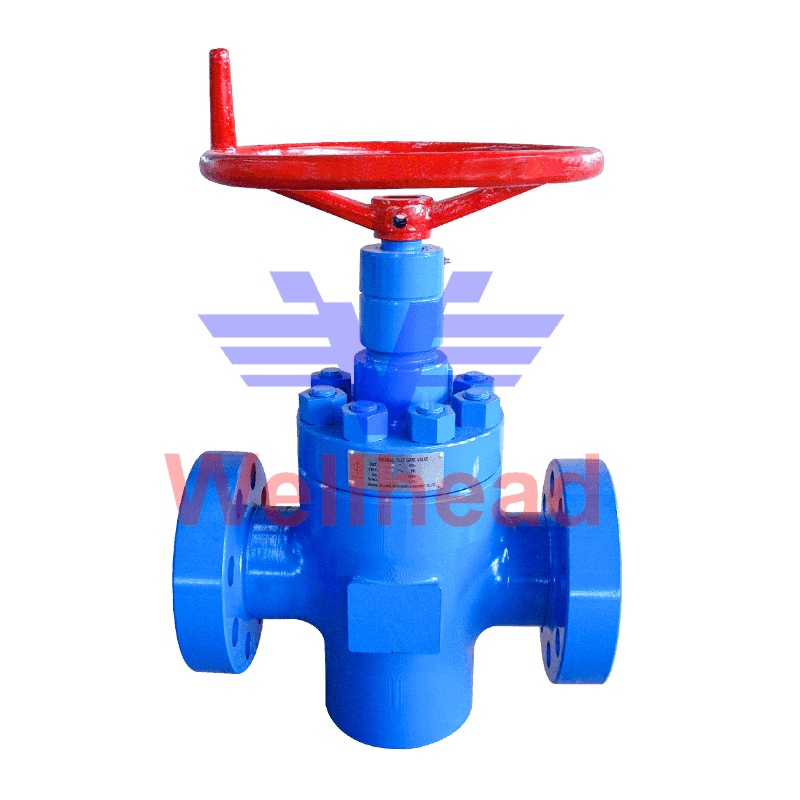 API 6A FL Flat Gate Valve for Wellhead IsolationThis full-bore, bi-directional flat gate valve is built to API 6A standards for high-pressure, high-temperature, and corrosive wellhead service, ensuring reliable shutoff of tubing and casing flow.View Product →
This range is why operators choose API 6A gate valves for critical shutoff duties instead of general-purpose industrial gate valves.
Check Valves
Check valves prevent backflow without manual intervention, and API 6A defines two main styles: lift check valves for clean fluids and moderate velocities, and dart check valves for high-velocity and abrasive services.
- Lift check valves — spring-assisted vertical-lift closure for clean service.
- Dart check valves — streamlined dart closure with good erosion resistance and tight shutoff under high flow rates.
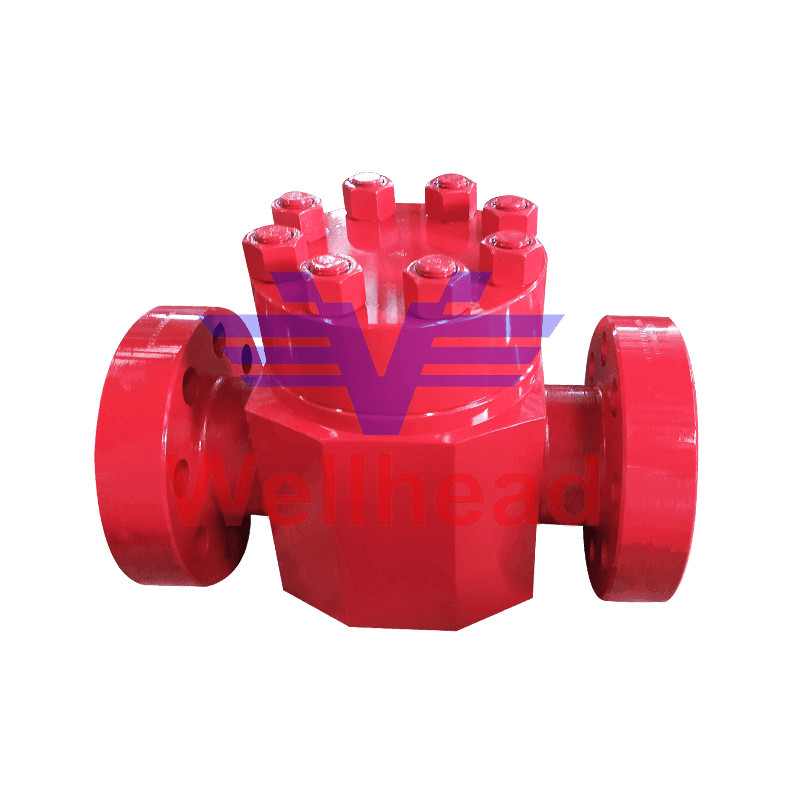 API 6A Lift Check Valve for Backflow PreventionDesigned to API 6A standards with a quick-opening lifting structure, this check valve delivers zero-leak sealing and durability, making it suitable for clean fluids and moderate velocity applications.View Product →
Choke Valves
Choke valves regulate flow rate and create controlled pressure drops, making them the core of choke-and-kill manifolds, injection skids, and well testing systems.
- Adjustable choke valves (H2 type) — continuously variable flow area for throttling.
- Positive and stationary choke valves — fixed orifice for predictable pressure drop.
- Plug-and-cage and orifice chokes — precision trim configurations for fine control.
- Hydraulic and electric actuated chokes — remote and automated flow control.
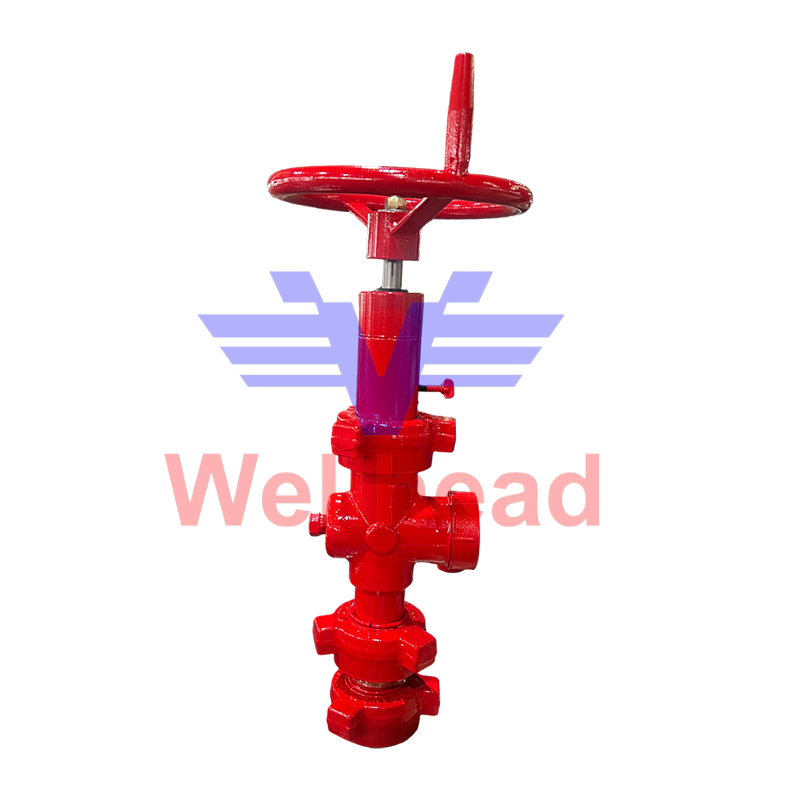 H2 Adjustable Choke Valve with Hammer Union ConnectionsThis manually adjustable choke valve offers precise flow and pressure control via a throttling member, suited for corrosive and high-temperature media in choke-and-kill manifolds and well testing systems.View Product →
Safety Valves
API 6A safety valves are fail-safe, remotely actuated shutoff valves — typically surface safety valves — that close automatically when the hydraulic or pneumatic control pressure is released.
- Hydraulically operated safety valves — spring-and-pressure fail-closed design, standard on production trees.
- Pneumatically operated safety valves — fast response for wellsite and facility emergency shutdown systems.
API 6A vs. API 6D: Key Differences
API 6A and API 6D are often confused, but they govern different parts of the oil and gas system: API 6A covers wellhead and Christmas tree equipment, while API 6D covers pipeline valves used in transmission and distribution service.
| Feature | API 6A Wellhead Valves | API 6D Pipeline Valves |
|---|---|---|
| Application | Wellhead, Christmas tree, well-control manifolds | Transmission and distribution pipelines |
| Valve types | Gate, check, choke, and safety valves | Ball, gate, plug, check, and butterfly valves |
| Pressure ratings | 2,000–20,000 psi working pressure | Typically ASME B16.34 Classes 150–2500 (up to about 6,000 psi) |
| Quality and testing | PSL 1–4, PR1/PR2, gas testing per PSL | Rate qualification per API 6D; fire-safe and DIB testing |
| Sour service | Material classes AA–FF per NACE MR0175/ISO 15156 | Material selection per NACE; generally less stringent |
| End connections | Flanged, hub/clamp, weld-end | Flanged, butt-weld, wafer/lug |
The practical rule is simple: do not substitute an API 6D pipeline valve for an API 6A wellhead valve. The pressure ratings, testing regimes, and sour-service requirements are not interchangeable.
How to Select the Right API 6A Valve
Select an API 6A valve by matching five parameters to the documented well data: pressure rating, temperature class, material class, PSL, and actuation requirement.
| PSL | Typical Use | Key Requirements |
|---|---|---|
| PSL 1 | Low-risk, standard service | Baseline design and limited NDT |
| PSL 2 | Normal production wells | Full pressure testing, material traceability |
| PSL 3 | Sour service, offshore | Charpy impact testing, stricter NDT |
| PSL 3G | Gas and high-consequence service | PSL 3 plus additional gas-service NDT requirements |
| PSL 4 | HPHT, subsea, critical installations | Most stringent controls and documentation |
The remaining selection steps are:
- Pressure rating: standard API 6A working pressures are 2,000; 3,000; 5,000; 10,000; 15,000; and 20,000 psi. Choose a rating above the maximum anticipated wellhead pressure, including shut-in peaks.
- Temperature class: classes K through V span arctic to high-temperature service; match the class to the recorded minimum and maximum flowing temperatures.
- Material class: classes range from AA (general service) to CC, DD, EE, and FF (sour service at increasing temperatures); base the choice on the fluid analysis per NACE MR0175/ISO 15156.
- Performance requirement: select PR2 when severe pressure and temperature cycling is expected, or when the valve is part of a safety system.
- Actuation: manual, gear, hydraulic, pneumatic, or electric — choose based on remote-control needs and required emergency shutdown response time.
Maintenance, Testing, and Long-Term Reliability
An API 6A valve's long-term reliability depends more on a disciplined maintenance program than on the initial purchase; the original design and the maintenance plan work together.
- Function-test all safety and actuated valves on the scheduled interval — monthly, quarterly, or per operator procedure.
- Lubricate stems, ball screws, and actuators with compatible grease.
- Re-torque flange and clamp connections after temperature cycles.
- Top up sealant in valves with sealant-injection capability, such as FLS types.
- Perform pressure testing per API 6A Annex F or company procedure after any intervention.
- Inspect trim for erosion and corrosion when the well produces sand, CO2, or H2S.
Practical steps for keeping these valves in service are described in more detail in our guide to long-term reliability of API 6A gate valves.
Frequently Asked Questions
What pressure ratings are available in API 6A valves?
API 6A valves are rated at 2,000; 3,000; 5,000; 10,000; 15,000; and 20,000 psi working pressure. The chosen rating must exceed the maximum anticipated wellhead pressure, including any surge or shut-in peak.
What is the difference between PSL 2 and PSL 3?
PSL 3 adds Charpy impact testing, more demanding NDT, and stricter material verification compared with PSL 2. It is normally specified for sour service, offshore wells, and installations where a failure would have high safety or environmental consequences.
Can API 6A gate valves be used for throttling?
Gate valves are isolation valves, not throttling valves. For flow control, use an API 6A choke valve with an erosion-resistant trim; using a gate valve in a partially open position damages the seat and gate.
Are API 6A valves suitable for sour service?
Yes, provided the material class (CC, DD, EE, or FF) matches the H2S partial pressure and temperature conditions, and the trim materials comply with NACE MR0175/ISO 15156. Confirm the PSL and material class on the datasheet before purchase.
Can API 6A valves be automated?
Yes. API 6A valves accept hydraulic, pneumatic, and electric actuators, and actuated safety valves are mandatory elements of most wellhead shutdown systems. The actuator must be selected with the valve's required fail-safe position, operating time, and control signal in mind.
Jiangsu Wellhead Drilling Equipment Co., Ltd. designs and manufactures API 6A gate, check, choke, and safety valves under a current API 6A monogram license, with four workshops, CNC machining, automated welding, and coating capabilities in our Yancheng facility. When evaluating suppliers, compare PSL and PR declarations, material-class documentation, and factory test reports — the specification, not the brochure, determines performance at the wellsite.
 + 86-0515-88429333


 CONTACT US
