

 English
 русский
Blowout prevention is the combination of drilling-fluid monitoring, well-control procedures, and mechanical barriers that stops formation fluid from flowing out of a well uncontrolled. The core of that system is the blowout preventer (BOP) stack, a set of high-pressure shut-off devices mounted on the wellhead. A kick happens when formation pressure overcomes the hydrostatic pressure of the mud column; a blowout is the uncontrolled result when that kick is not contained. The BOP stack is the final mechanical line of defense, which makes it essential reading for drilling crews, well engineers, and procurement teams.
This guide explains what causes a blowout, how each part of a BOP stack reacts, how the equipment is tested and maintained, and what to consider when selecting a blowout prevention system.
Content
What Is a Blowout and What Triggers It?
A blowout is an uncontrolled release of oil, gas, or water from a well that occurs when the primary barrier — the drilling mud column — no longer exerts enough hydrostatic pressure to hold back the formation.
Drilling mud is weighted so that its hydrostatic pressure slightly exceeds the pressure of the formations being drilled. When that balance is lost, formation fluids enter the wellbore and create a kick. Common triggers include:
- Mud weight too low for the formation pressure being drilled.
- Swabbing, which pulls fluid out of the well when the drill string is pulled too fast.
- Lost circulation, when mud escapes into a permeable zone and the fluid level drops.
- Encountering an unexpected high-pressure or abnormally pressured zone.
- Late kick detection or slow operational response.
A kick is not yet a blowout. If it is detected and shut in quickly, the well can be circulated clean and weighted back up. If ignored, gas and lighter fluids rise, expand, and can unload the hole, at which point surface equipment may be overwhelmed. That escalation is exactly what blowout prevention is designed to interrupt.
How a BOP Stack Prevents Blowouts
A BOP stack prevents a blowout by sealing the wellbore mechanically at the surface or the seafloor, giving the crew time to restore primary well control. It does this with a layered combination of annular and ram-type preventers, supported by high-pressure piping and a hydraulic control system.
The components work as a single, rapidly activated system. When the crew detects a kick, they close one or more preventers to trap pressure inside the well, then use the choke and kill lines to circulate the kick out and replace the mud weight.
Annular Preventers
An annular preventer is the most flexible sealing element in the stack: it can close around drill pipe, tool joints, casing, and even seal an open hole. A rubber packer element is squeezed inward by hydraulic pressure to conform to whatever is in the wellbore, making it the fastest general-purpose sealing device on a rig.
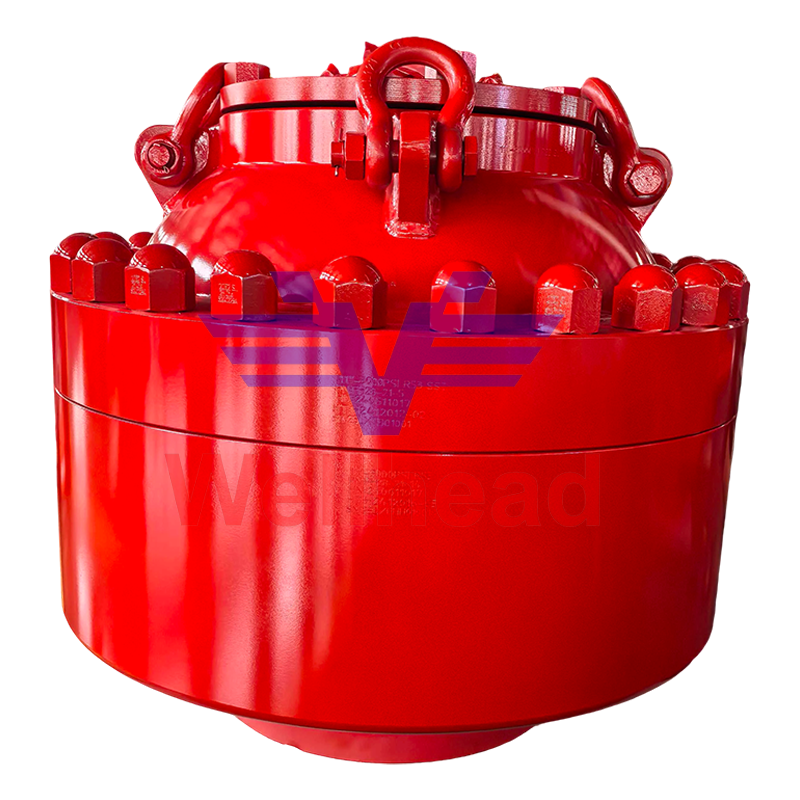 Annular Blowout Preventer with Flexible Sealing for Quick Well ControlThis annular BOP uses a rubber packer to seal around various tubulars, offering fast, general-purpose shut-in for rigs. It is designed for stable performance in high-pressure environments, though it is not meant for extended pressure holding without ram support.View Product →
Annular preventers are usually positioned at the top of the stack, so they are the first element to close and the last to open. They tolerate limited rotation and stripping, but they are not designed to hold pressure indefinitely — a set of rams below them carries the load during prolonged shut-ins. For a closer look at how modern designs improve sealing reliability, see how annular BOP performance drives technological innovation.
Ram-Type Preventers
Ram preventers use paired steel blocks, or rams, that push together from opposite sides to seal around or cut through the drill string. Each ram type is built for a specific job, so a stack usually carries at least three of them.
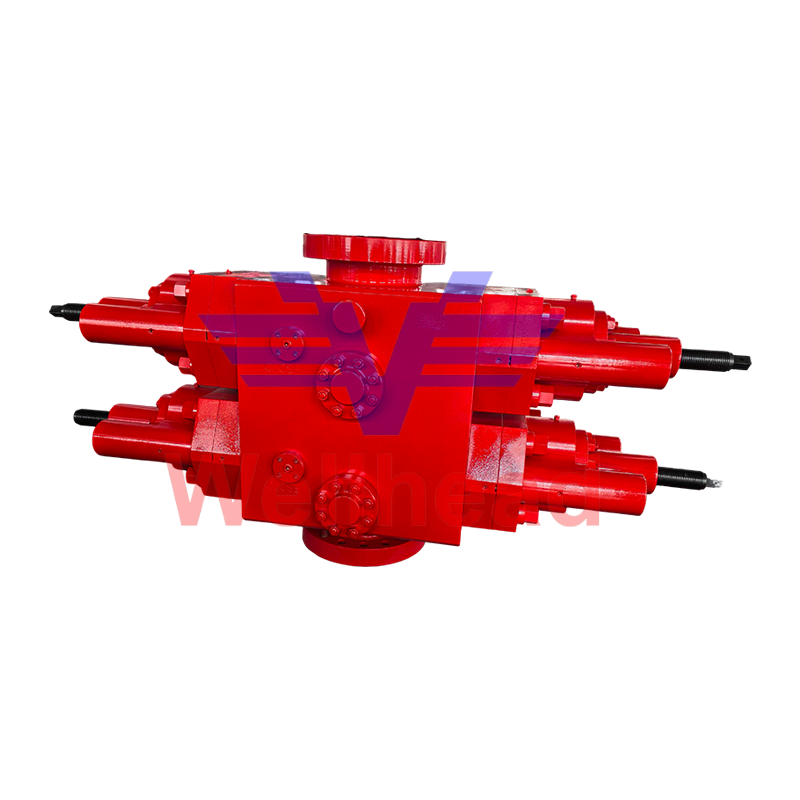 Double Ram BOP with Dual Sealing Barrier for Space EfficiencyThis double ram BOP combines two sets of rams, such as pipe and blind-shear, to provide dual sealing in a compact height. It responds quickly to pressure changes, forming a reliable wellhead barrier that suits various drilling operations and reduces connection points.View Product →
| Ram Type | What It Seals Against | Typical Use |
|---|---|---|
| Pipe rams | Drill pipe of one nominal size | Holding the well around the string during normal shut-ins. |
| Variable bore rams | Several pipe sizes within a range | Adjusting to different string sizes without changing rams. |
| Blind rams | An open wellbore — no pipe | Sealing the well when the drill string is out of the hole. |
| Shear (shear-blind) rams | Cuts the drill pipe, then seals | Last-resort closure, especially for emergency disconnects offshore. |
In a typical land stack, a double ram preventer contains two sets of rams, often a pipe ram and a blind-shear ram, which saves height and reduces connection points. Various operating options are available depending on rig configuration.
Supporting Equipment That Completes Well Control
No BOP closes a blowout by itself — the surrounding manifold and control systems are what make a shut-in safe and effective.
- Choke manifold: a set of adjustable and fixed chokes that routes well fluids through a controlled restriction so backpressure can be maintained while the crew circulates out a kick.
- Kill manifold: a smaller-diameter line that pumps heavy mud directly into the well below the BOP to restore hydrostatic pressure.
- Accumulator unit: a bank of pre-charged hydraulic bottles that stores enough energy to close every preventer even if rig power is lost.
- Control panels: remote stations on the rig floor and a backup location that let the driller and the toolpusher actuate each preventer independently.
 Choke Manifold for Precise Wellbore Pressure RegulationThis choke manifold uses throttle valves to control wellbore pressure during drilling and kill operations. It is rated to match BOP stack pressure, ensuring a safe pressure-containment path. Its design includes various valve types to accommodate different well control scenarios.View Product →
The choke and kill manifolds are rated to the same working pressure as the BOP stack because they become the well's pressure-containment path during a kill procedure. Choosing manifolds with matched pressure ratings, flanges, and valve trims is as important as choosing the BOP itself.
Testing and Maintenance: Proving the BOP Works
A BOP that has never been tested is a plan, not protection. Function tests and pressure tests must prove that each preventer opens, closes, seals, and holds pressure exactly as designed, before spudding a well and at regular intervals afterward.
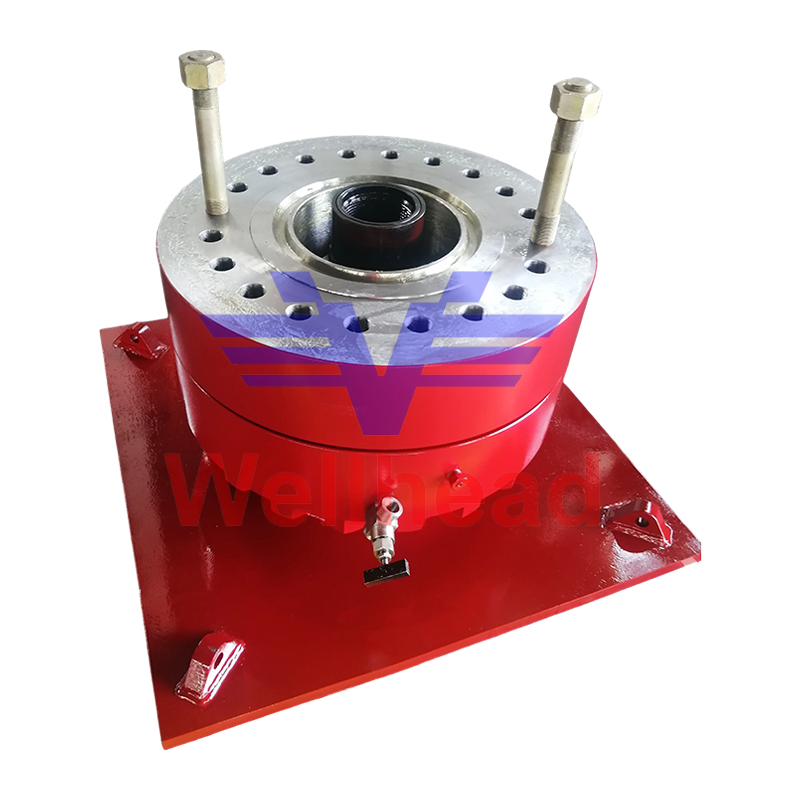
Function tests confirm that rams close and seal around the correct pipe size, the annular packer activates, and the control system responds within the required seconds. Pressure tests apply a low-pressure test (usually 200–300 psi) followed by the full rated working pressure, because an element can seal at high pressure yet leak at low pressure. This is why a dedicated BOP test stump is an indispensable piece of rig-site equipment: how the BOP test stump became essential for blowout prevention explains the role it plays in verifying seals before the BOP ever sees the wellhead.
Common industry practice is to pressure-test the BOP on a 14-to-21-day cycle, plus before drilling out the casing shoe and after any repair. Seals, packers, and ram blocks wear with every closure, so regular inspection and replacement of elastomers is a normal part of BOP ownership. Documentation of every test also forms the audit trail demanded by regulators and well owners.
How to Choose a Blowout Prevention System
Selecting a BOP starts with the working pressure rating and bore size that match the well plan, then considers ram configuration, closing unit, and material trim for the fluids and temperatures expected.
- Working pressure rating: match the BOP to the surface pressure the well can realistically generate, from 2,000 psi for shallow wells up to 15,000 psi for deep, high-pressure reservoirs.
- Bore size: the vertical opening must pass the largest bit, casing, or tool that will run through it, usually measured in inches.
- Ram complement: choose pipe rams for the anticipated string sizes, at least one blind or blind-shear set, and consider variable bore rams where multiple sizes are run.
- Close-in time: the accumulator and control system must close every preventer within API-specified time limits, typically 30 seconds or less.
- Material and H2S trim: sour service requires hydrogen-sulfide-resistant materials and elastomers rated for the expected temperature range.
- Certification: look for API 16A monogrammed equipment, an API Q1 quality system, and third-party verification from bodies such as ABS, BV, or CCS where project specifications require it.
| Rating (psi) | Typical Application |
|---|---|
| 2,000 – 3,000 | Shallow land wells, low-pressure formations, some workover operations. |
| 5,000 | Standard onshore production and drilling, many platform wells. |
| 10,000 | Deep and high-pressure land wells, most offshore subsea stacks. |
| 15,000 | Ultra-deep, high-temperature, high-pressure wells. |
Ram configuration should always be planned around the worst-case string in the well program, not the most common one. If the well plan changes formation or casing programs mid-course, the BOP stack should be re-reviewed.
Frequently Asked Questions
Quick answers to the questions operations and procurement teams most often ask about blowout prevention.
What is the difference between a BOP and a wellhead?
The wellhead supports the casing strings and contains pressure during drilling, while the BOP sits on top of the wellhead and provides the shut-in capability. During production, the BOP is removed and a Christmas tree takes its place.
How fast does a BOP close?
API-recommended closing times are generally 30 seconds or less for annular and ram preventers; many modern hydraulic systems close individual rams in well under 10 seconds. The accumulator must hold enough stored energy to close all preventers even with rig power off.
Can a BOP prevent every possible blowout?
No. The BOP is only as effective as its testing, maintenance, and the crew's response. A kick that goes undetected, a weak test, or a worn packer can reduce the system's ability to seal. Blowout prevention is a system: trained people, reliable procedures, and tested equipment working together.
How often is a BOP tested?
Standard practice is a pressure test at least every 14 to 21 days during drilling, a more frequent function test (often each shift or weekly), and a full pressure test before drilling out the casing shoe or after any intervention on the stack.
 + 86-0515-88429333



 CONTACT US
